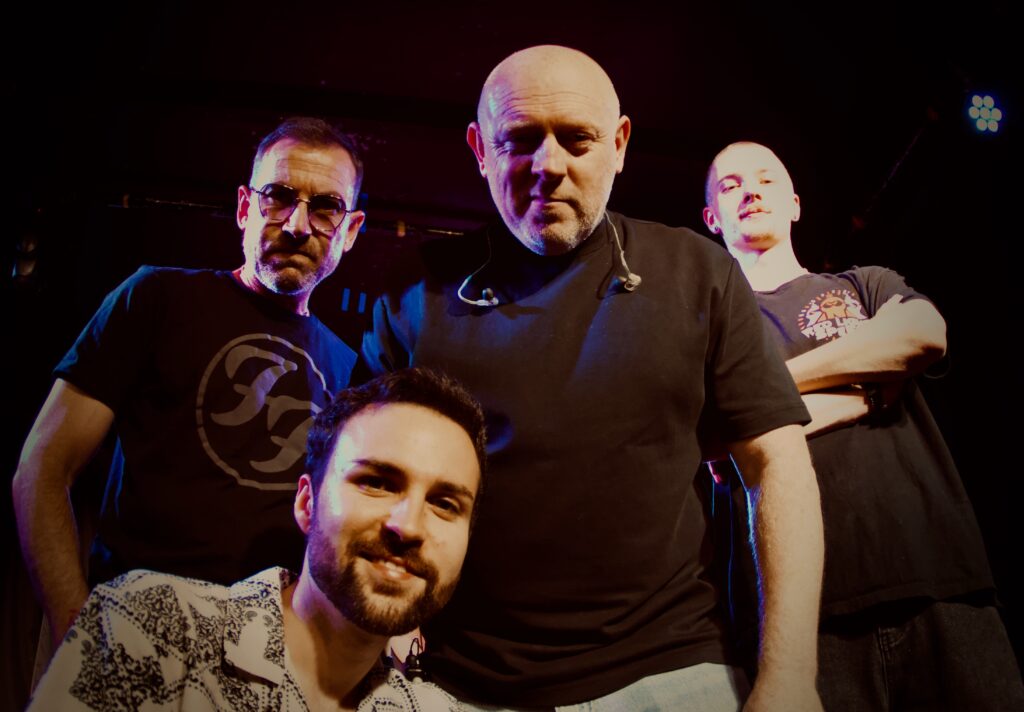
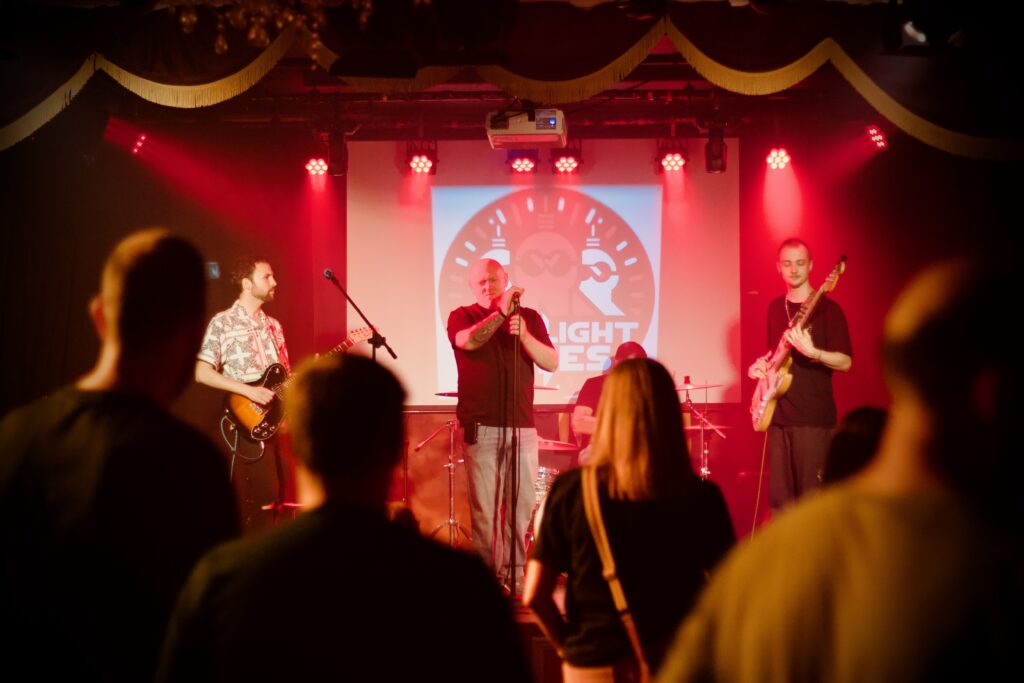
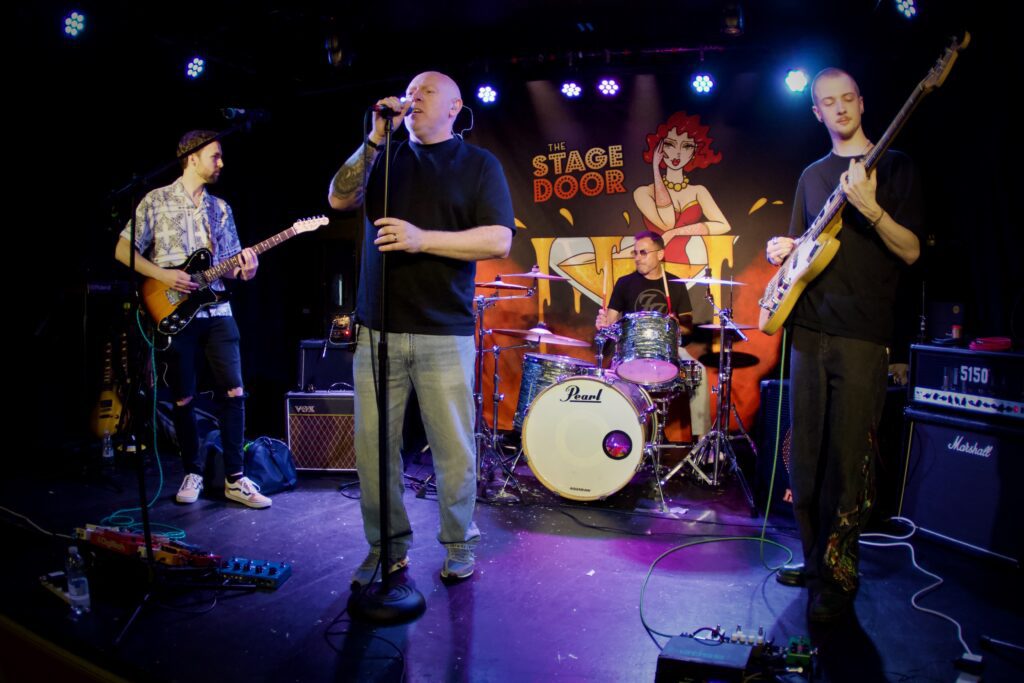
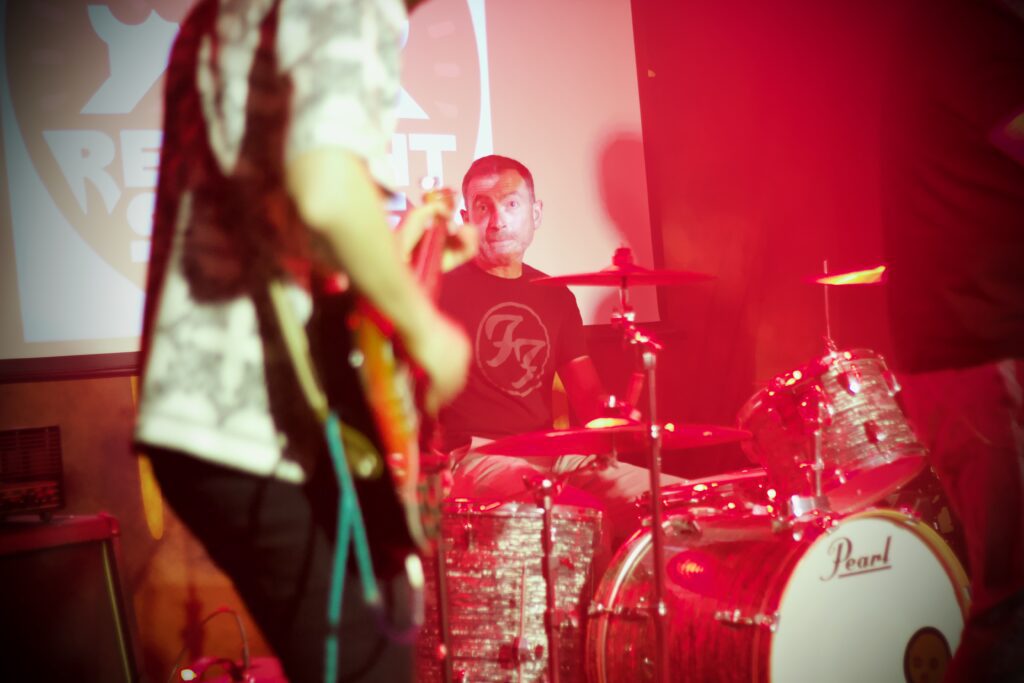
Red Light Spies interview recorded live at The Stage Door, Southampton. We sat down with the band to discuss their influences, writing music and their future.
Band Members
Paul Nimmo — Vocals
Dave Villar — Guitar
Will Morse — Bass
Steve Kingman — Drums
Location & Date
The Stage Door
20 June 2026
Interview Transcript
Stage Door, Southampton — 20 June 2026
Bryan (Music Scene Magazine):
Okay, um, so we are at, which one’s this? Stage Door. It’s the 20th of June. Christ, we’re through the summer already. And I’m sat with Red Light Spies. So, um, what I wanna do, gents, is just very quickly go around the table and just tell me your name and the role you have within the band. So we’ll start with yourself, Sir.
Dave:
Hello, I’m Dave. Um, I’m the only guitar.
Paul:
I’m Paul, so I’m lead vocals.
Steve:
I’m Steve, I’m the drummer.
Will:
I’m Will, I’m the bassist.
Bryan:
Okay. Well. And it seems to be working. I’m gonna… Yeah, that’ll do. Yeah. So, um, Red Light Spies, um, it’s a name that instantly makes people curious.
All:
Yeah. Yeah.
Bryan:
Like, where did it come from? What’s the story behind it?
Steve:
Well, I can normally tell this story, uh, ’cause we’ve been asked it a few times.
Um, when we first got together… Well, we were, we were a covers band before. We’d been together for years, but, um, three, four years ago, we decided to ditch the covers, and we were gonna do an originals project.
So we thought, “Right, we need a, we need a decent name, something a little bit different. People that might, you know, catch some, uh, people’s attentions.”
So we’ve got a band group chat obviously, so we, um, we just threw a few ideas.
Yeah, we, so we just threw, uh, threw band name ideas into the group chat, and lots of them were rubbish, obviously.
So, yeah, so one day, um, I think one of the lads, don’t know who it was, one suggestion came in was Red Light, and then the next suggestion came in instantly was Spies.
So on the screen there was Red Light Spies, and we all thought, “Oh, that sounds a bit cool, a bit catchy, a bit different.” So that’s how the band name came about.
Um, and if you believe Google, since we’ve Googled it, the actual term Red Light Spies, um, it is an old Cold War term given to, um, spies back in the Cold War days. They used to use infrared torches to avoid detection.
So that is the showbiz answer. But the actual real answer is we just made it up.
Bryan:
So, um, I’ve been quite blessed this week ’cause some great Einstein sent me a Spotify link, and music’s been on repeat, um, since your name was chucked over to us at Music Scene Mag. And listening to your music, which I like—
Will:
Thank you.
Bryan:
There’s, there is a certain confidence and maturity to it, if that makes sense.
Steve:
Yeah.
Bryan:
Um, how long did it take for the band to find that sound? Um, and what made it yours?
Paul:
Um, so the songs are nearly 20 years old, which I wrote, um, with a fellow acoustic guitarist, jamming. And then they got put in a box, never to return, until we were in a covers band together.
And I’d had enough of doing covers, like the lads did, and I said, “Listen, I’ve got about five or six tracks here. Do you fancy seeing what they sound like?”
And I have to give credit to the boys. Um, we turned basic acoustic songs, um, ideas into the tunes that are on Spotify now.
So that sound that you’re hearing and the maturity of it, I suppose, is the lyrics and the meaning of those songs are of what happened in the early 2000s in my world, which probably still resonates today as well to other people.
Relationships, um, loneliness in some of the songs, especially with Raining on My Back.
Um, and the guys and us created this sound in my garage at the bottom of the garden, which I cleared out for rehearsal space, and we recorded that EP in there. So all them tunes are all bouncing off concrete blocks.
Bryan:
So every band has its influences. And before I read your About Us on Spotify, I could already pick out some bits that it’s like, they’re very hmm, or they’re very hmm, or I can hear that there. Now, there comes a point when you stop sounding like and you start making your own sound, and when do you think that was for you guys?
Steve:
I think it was Raining on My Back, really.
Yeah.
Um, the first four, um, the Infrared EP, um, was basically, I guess, driven out of the sort of indie rock scene—
—of the sort of late ’90s, well, mid-late ’90s, I guess. I mean, that’s where me and Paul sort of hail from. Um, and the boys obviously love that sound as well.
Um, so I think it just naturally happened that way, really.
Um, but with Raining on My Back, it’s kind of totally different. Dave came up with this super cool intro.
Will:
We all just stopped and—
Steve:
And we didn’t have anything after that. Well, we had the song obviously; we didn’t have anything after that intro.
Um, but we knew that had to be the start of something new and different. So that’s how that song started.
Um, and obviously as a band, we built that song basically around that intro. Um, and it sort of evolved from there, and it’s kind of developed into a unique sort of sound, I think.
Dave:
It was starting to get a, um, different song, uh, different sounds to the songs, you know. As Paul said earlier, getting a… It was like a one-minute, one-minute-and-a-half acoustic idea, and getting that and trying to evolve it into a full song.
But especially the four, uh, the first four songs, they still had more of its style from when they were written.
I think you’re right. Um, with Raining on My Back, we started to shape it a little bit more, and even more now with the new ones that we are… We will perform a couple of them tonight.
Bryan:
And what drives the songwriting in the band? Is it personal experiences, observation, storytelling? What’s kind of been the fundamental thing behind that for you?
Paul:
I think I’ve always written in previous bands where the guys jam. Dave will bring an idea. Bass, drums connect.
If it connects with me personally, that I feel as though there’s a song there, I’ll normally record it. I’ve got a little recorder, go away, listen to it on my own.
I need to be on my own to just drop ideas and throw melodies at it, and then I may have some sessions with Dave, just on the guitar, just to structure it so we’re not wasting time in rehearsals, and then bring it back to Will and Dave and create it.
But we have had songs where we’ve had a rehearsal session, and they’ve just kicked in. It’s mental how it happens, innit? It’s just like—
Dave:
Yeah.
Paul:
When it flows… We’ve got a new one. We’ve got three or four on the go, but one’s called On The Bones. It’s not been played yet. It’s gonna be coming out in the next two months, but that one, it just started and arrived on a jam and ended, and the song was there.
Dave:
It’s really good.
Paul:
I had to sort the lyrics out ’cause there was a lot of fucking waffle going on, but—
The structure was there.
Bryan:
That’s when you walk away from a practice session or rehearsal and just grin—
Paul:
Yeah. And go—
Will:
That’s a good line.
Paul:
And then you can work on a tune and overthink stuff and kill the idea off. So I think we’re all, um, focusing on there’s a bit of magic there, and we fucking hold onto it and try and work with it.
Steve:
I think that we’re gonna play a couple tonight. One’s called Crook. It was probably written in about five minutes.
Paul:
That was the one we just played, that last one, yeah.
Steve:
Yeah. And we’re gonna play Maria, which took about five months—
Dave:
Yeah.
Steve:
—to actually get out. Honestly—
Dave:
It took ages.
Steve:
Yeah, just to get the structure right because it’s quite dynamic. It’s quite different structurally. Um, and we knew it was good, but we couldn’t really get it right, and all of a sudden we got it.
But, um, yeah, that took a long time.
Paul:
Took a bit of effort.
Bryan:
Now, um, looking at the music industry today, do you think it’s easier or harder for a band like Red Light Spies to break through than it would’ve been 20 years ago?
Paul:
Well, interestingly, I was doing the Joiners in 2000, 2001, 2002, and we had the opportunity as local bands to support live, uh, signed bands coming through.
Now, I messaged the Joiners only a couple of months back and made reference to that, uh, on a social media page, and he said, “Paul, we don’t do it as much now because these signed bands bring their own support.”
So that’s killed off opportunities for young local bands to get a sniff playing with a band that’s been signed and getting exposure playing with someone like that.
So I would personally say, yes, it’s definitely changed from then and the opportunities.
The game’s changed. The game’s changed, and it’s all driven by social media— mm-hmm —um, which can be a benefit and also a hindrance if you’re not on it all the time.
Bryan:
An off-the-cuff question is, do you think it’s more about control by the record labels and the promotions teams?
Paul:
I think we’d all like to experience that, ’cause we wouldn’t know.
I mean, we know how hard Miriam works, our manager, to try and get us gigs and set up showcases, but if you’re not gonna fill a venue out, you’re not gonna get on again, and they want… Obviously, it’s a business. More tickets you sell, the bar’s getting filled.
The till’s getting full. So, uh, yeah, it’s— mm —it’s more challenging, but you’ve got to have someone driving it, and we’re lucky enough to have Miriam there pushing it out and networking with good people to see where that can take us.
Bryan:
Which leads me on to my question: what’s the biggest lesson you’ve learned, um, being in a band that nobody tells you when you’re first starting out?
Steve:
Ooh, tough question.
Paul:
Always bring a rug for the drum kit.
Steve:
Or ducktape.
Paul:
That’s always a— that’s always a start.
Bryan:
I think it was carpet or Lino back in the day, wasn’t it?
Paul:
Yeah.
Steve:
I think it’s really important to connect as people and friends.
Will:
Yes.
Will:
It’s not just the music anymore. It’s the conversations you have—
RLS Steve:
Yeah.
Will:
—around it.
I think we’ve all been in bands before where you’re not playing with your friends or you’re just playing with other people’s egos, and—
Dave:
You get together, you’re playing with other people, but it doesn’t click.
Will:
Yeah.
Dave:
And if that click is not there, the music won’t be there. You won’t be able to transmit what you want to the floor.
Steve:
We socialise and we’re friends off stage as well as on it, you know, so, um, and I think that adds, that gives us a bit of a head start really.
You know, we all enjoy each other’s company, and we love getting together in a rehearsal room or down the pub for a beer, you know, so.
Paul:
What we’ve got, you don’t take for granted. We’re very lucky.
We’ve got the band’s certain, uh, stands of the age. Me and Steve, the old war dogs, and we’ve got the young lads here coming through.
So we’ve got a few scars for it, but I said to the guys, “Cherish this bit because you may never find another band in the future that locks in.”
And for us, we’ve got a united sort of, um, friendship. Regardless of what our ages are, we connect, especially with the band, don’t we?
Dave:
Yeah.
Will:
Yeah, 100%.
Bryan:
And when you’re writing and arranging new material, what tells you a song is ready to leave the rehearsal room?
Paul:
Well, Steve will tell you as soon as we’ve jammed it. It’s ready to gig.
We can do that.
We can gig that.
Paul:
I personally look for the band, the musicians, uh, Dave, Will, Steve really. Uh, if it’s tight and they’re saying, “It’s good,” then I’ll go with it.
Will:
I think it’s until I remember the bass line is there.
Steve:
Yeah.
The ones you—
Will:
If I don’t remember it—
Steve:
The ones you can be bothered to—
Will:
Yeah, pretty much.
—remember.
Paul:
We’ve all got comfortable, haven’t we?
You know, Dave wants to work on it a bit more and come up with another, um, lead solo, or Will’s still, you know, umming and ahhing over a certain bassline, then we’re not ready.
But once we have the QA check and the guys are ready to go live and we’re tight, then we’re all in there.
Bryan:
If everything goes according to plan over the next three years, where is Red Light Spies going to be?
Will:
Retired.
Steve:
No, we were asked this before and my answer was the Pyramid Stage. Not headlining, but maybe the first one on a Friday, you know.
Will:
Yeah.
Paul:
I think we’re at this stage now, we’ve got another four or five songs that we’re going to be going into a studio with a new producer.
I’d like to be saying we’re ready for the next level now, and we want what’s owed— if our songs are that good, we want people to take notice, and we want those good gigs and that exposure.
Bryan:
So what is it you want people to remember about Red Light Spies after they’ve seen you for the first time?
Steve:
I think it’s good when people come along and they see it for the first time, they listen to us.
They obviously, well, some of us, maybe not, but some people obviously like it because you see the Instagram followers go up and go up.
You get a few new followers all the time and you sort of think, okay, yeah, people are listening to this and are liking it and they’re clicking on this page, and it is slowly creeping up, you know.
Bryan:
What about when you’re actually on stage looking at the audience? It’s like, because for me it starts with a foot tap.
Paul:
It’s a connection. We get interaction from the audience and it’s obviously a great feeling, isn’t it?
You’re a band, you’ve been rehearsing, you’ve written, you’ve put a lot of effort in, connecting with people, even if it’s just one person at the back tapping and no one getting into it.
Yeah. I like them to come away going, “I didn’t know who they were before I came tonight, and now I’m following them. Now they’re in my playlist, now they’re in their car, and we’re in their lives.”
And when we release something else, they get first dibs on it.
Dave:
At least they’ve come to the gig, they’ve been 30, 40 minutes, an hour or whatever it is, and they’ve put all their worries aside and they’ve been enjoying some music.
Paul:
Yeah.
Dave:
That makes us happy.
I’ll say that.
Bryan:
That’s the end of the official questions. Now we’re going to just… Your influences. So, I’ve got a bit of Arctic Monkeys.
Steve:
Yeah.
I’d say that would be one of the top.
Bryan:
I would probably guess that you’re not far off my age, probably a bit younger, and I’m thinking your tastes, I don’t think, are too dissimilar to mine, what you’d probably listen to in the ’80s and the ’90s. You didn’t have any sort of, like, Marillion leanings in there back in the day, did you?
Paul:
So, um, you’re the second person to say that.
Um, we done a gig down there and this guy had just seen Fish the week before, and he said—
Bryan:
Now there it is.
Paul:
And I do love Marillion, and their songs have been part of my life growing up in the mid-to-late ’80s into the ’90s. Fucking hell, yeah.
Bryan:
Misplaced Childhood for me was on— well, it wasn’t on repeat because it was a fucking tape. I used to have to find it. Sorry, excuse me.
Paul:
All of those. Marillion, Talk Talk, Simple Minds. From the very first gig in 1989— Jim Kerr, live at Wembley Arena. It’s not there anymore.
So I sort of grew up into them, then I hit me sort of 16, 17, and I loved the Happy Mondays and Inspiral Carpets.
I moved on a little bit and we all got, we kind of had the tidal wave of Britpop that we all engulfed in, and grunge as we come into this.
But no, it’s interesting, isn’t it? As a kid, those songs, because the ’80s bands were probably the best. U2, early U2, all of them.
Bryan:
The production was amazing.
Paul:
Proper musicians.
Bryan:
There is one track on your Spotify, and I’ve not written it down, but I’ve listened to it on repeat, and I can’t remember which one it is, but it has leanings of Fish, Marillion, various echoes on the vocals. And I actually saw that— I heard it and was like, “Oh, back to the beginning.” Because I caught it in the office and it’s like the place was just on run. And it’s like, “No, no, no, no, no, no.” So I turned off the computer speakers, put them onto the monitors and sat there in front of the screen. It’s like, “Okay, now you’ve got my attention.” And for me, that was the one that went, “There’s something here. I think there is something here that we need to investigate.” Because obviously the email came through with the link and the details. And that— because the first thing I do is I will click on the Spotify link before I’ve read anything else. I’m not interested in reading because I just want to hear. Because that for me is the catalyst. It’s the same for Damien, the same for Harry. That’s the catalyst that makes us go like, “I really like this.” Now, again, music is a broad church. And I was saying that in two weeks’ time I’m going to a folk festival, which is interesting, not my run of the mill, but you’ve got to go because it’s about people creating and there’s music in it. It’s that whole process. And that was the bit for me, listening to that process and I think drawing on your experience and your— what drove you back then, what’s resonating in the back of your mind from when you were growing up to where it is now. And those leanings certainly come through. So, yeah, I’m glad I got it right about the Fish and Marillion because it definitely does show.
Paul:
Yeah, that’s nice.
Bryan:
Which is interesting in itself. And I think you guys have a sound that whilst you have that sound of… I want to say it’s an individual sound, it’s your own, but you can hear the influence of other parts. I mean there’s, I think on some of the tracks there’s an Alex Turner-esque tail end to some of the vocals.
Paul:
Yeah.
Bryan:
It’s not the same as, it’s completely individual, but there’s just a few phrases where it’s that, “Oh yeah,” it makes the difference.
Paul:
Thank you for that. I would say, surprisingly, I don’t look at it that way, but it’s great that people pick stuff up off all of our music.
Bryan:
I think one of the notes as well, there was a— I think, I’m sure on one of the notes, on one of the lead breaks— so this would be your department— there was almost a Carlos Santana-esque…
Dave:
Well, I’m Spanish, so it could be.
Bryan:
I didn’t know that when we were looking at it. There’s that nice undertone of Santana.
Dave:
That Crook that we just played has got a bit of a Spanish lead.
Dave:
That Crook had that, yes.
Steve:
Spaghetti Western type.
Bryan:
Well, thanks guys. For me, that’s a load of material. Hopefully not too inquisitive.
s
s